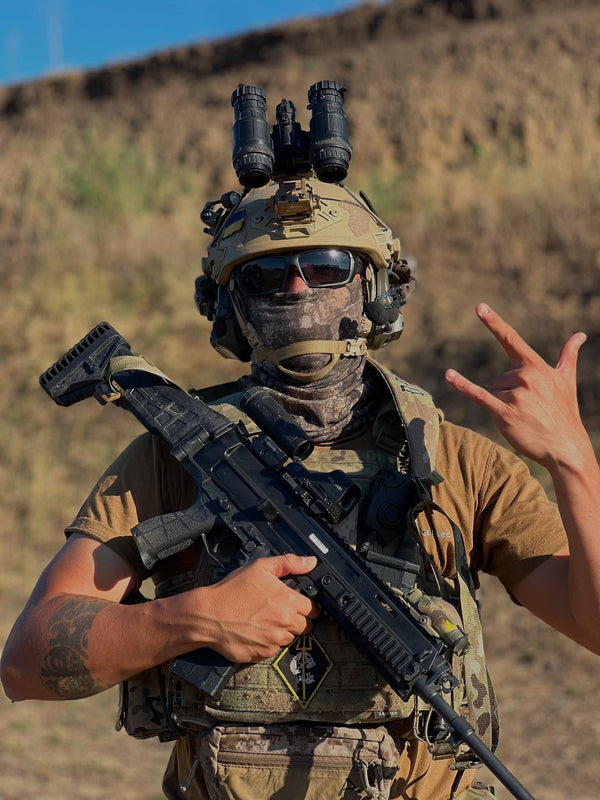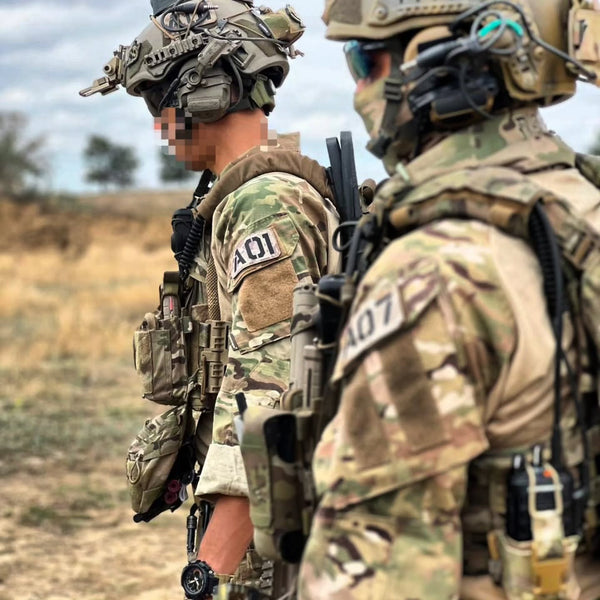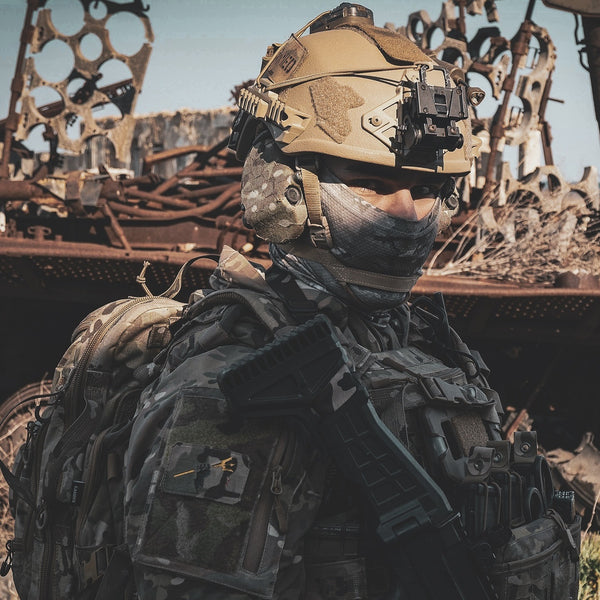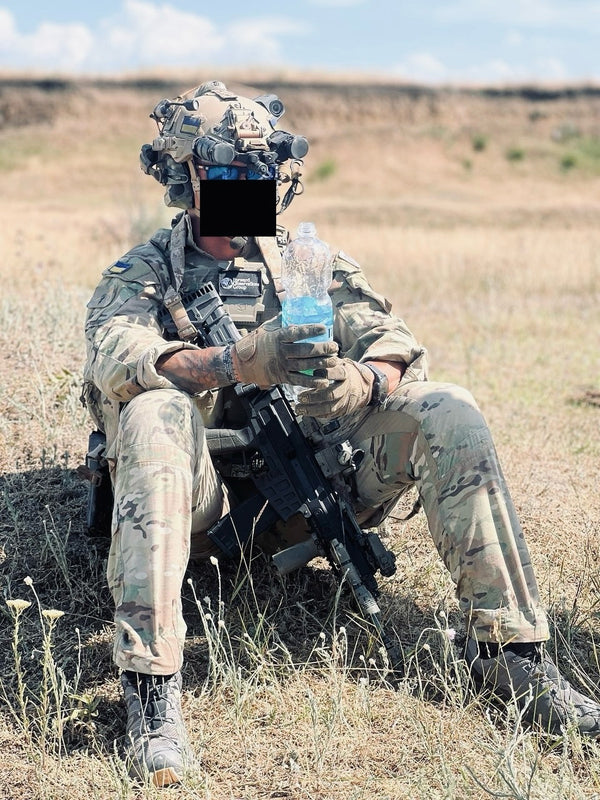


Most helmet setup problems trace back to one decision made before a single accessory was bought: the shell cut. Ear cups that won't seal, a light with nowhere to go, night vision that drags the helmet over your eyes — each of these starts with how the shell is shaped around the ears and what hardware it carries.
The cut decides four things: how your headset meets the helmet, how much you can mount, how the full loadout balances, and which parts survive a change of helmet. This guide walks through each of them for FAST, other high cut shells and MICH-type helmets, then finishes with three reference builds from our own kit line.
FAST, High Cut and MICH: What Actually Differs in the Shell
"High cut" and "MICH" describe how far the shell is cut away around the ears. FAST is not a third cut: it is a specific high cut platform with its own geometry and rail hardware. That distinction explains most compatibility surprises later in a build.
MICH. The Modular Integrated Communications Helmet was developed for US special operations and entered service in 2001. It was offered in three cuts: a full cut with ear coverage, a "gunfighter" cut that raises the shell around the ears by about half an inch, and a high cut that removes ear coverage entirely. The ACH and ECH are later derivatives of the same shape. When people search for a "MICH helmet setup", they almost always mean the full or mid cut, and that is how we use the term here.
FAST. Ops-Core introduced the name in 2005 for a high cut shell whose ear-cut line still wraps the back of the skull without hitting a plate carrier's collar. The system ships with side ARC rails and an NVG shroud built in. "FAST-pattern" helmets from other makers copy that outline and rail layout, which is why so many accessories are sold as "FAST compatible".
Other high cuts. Team Wendy's EXFIL is a high cut with a different outline and its own rail standard, Rail 3.0, plus a Wilcox shroud. ARC-type accessories fit it only through an adapter.
|
Profile |
Ear area |
Side rails |
NVG shroud |
What it means for the setup |
|
FAST / FAST-pattern high cut |
Open |
ARC-type, factory |
Factory |
Headset mounts on the rails; largest accessory ecosystem |
|
Other high cut (e.g. EXFIL) |
Open |
Proprietary, factory |
Factory |
Same logic as FAST; ARC gear needs adapters |
|
MICH full / mid cut |
Covered by the shell |
None as standard; bolt-on kits |
Only via factory holes |
Headset goes under the shell; mounting is added, not built in |
In our range, the FAST and ATE FAST helmets are FAST-pattern high cuts, the Exfil FAST follows EXFIL geometry, and the Middle-Cut Aramid helmet is a MICH-type mid cut. The FAST shell family itself — ballistic vs bump vs replica — is covered in our FAST helmet guide.
Comms: How Shell Cut Decides Your Headset Setup
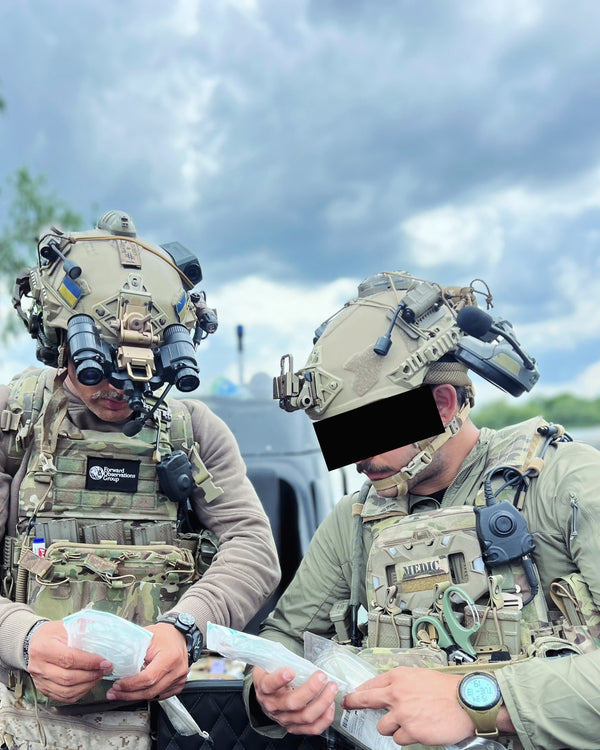
On a high cut helmet the headset hangs from the rails; on a full-cut MICH it sits under the shell on its own band. That one difference drives comfort, hearing-protection seal and how quickly you can go "ears off".
High cut and FAST: rail-mounted cups. ARC adapters replace the headset's headband and clip the cups straight onto the helmet rails. Peltor ARC adapters are built for reverse-dovetail rails such as those on Ops-Core helmets. The cups swing up to stow, clamp force comes from the arms rather than the shell, and nothing sits between your head and the pads. Our ComTac XPI and Earmor M32X Plus kits ship with these rail mounts already fitted.
The alternative on a high cut is a headband worn under the helmet. Ops-Core's FAST SF shell has a recessed groove for exactly this, so the helmet goes on and off without removing the headset. Choose it if you often run the headset without the helmet, for example on the range.
MICH: headset under the shell. A full or mid cut covers the area where the cups need to sit. The headset has to go on first, on its band or a behind-the-head neckband, and the shell edge then rests on or against the cups. In practice that means pressure points on long shifts and a cup seal that can break when the helmet shifts. Clearing this problem is exactly why the gunfighter and high MICH cuts were created.
Cable and PTT routing. With rail mounts, run the down-lead along the rail and under the cover edge towards the back, then down to a PTT on the chest or shoulder strap. Keep it clear of the chinstrap. Under a MICH the cable exits below the rim, so tuck it inside the cover edge where it cannot snag on a carrier or sling.
Common mistake: buying ARC adapters for rails that are not ARC, or for the wrong headset generation. EXFIL-type rails need an intermediate rail adapter, and 3M's current ARC adapter for ComTac VII/VIII does not fit earlier ComTac models.
Which headset to buy is a separate decision, covered in our tactical headset guide. Current models are in Active Hearing Protection.
Rails, Shroud and Accessories: Mounting Capacity by Cut
A high cut shell is a mounting platform out of the box; a MICH becomes one only with added hardware. What fits where depends on rail length, the shroud, and how much rail the headset has already taken.
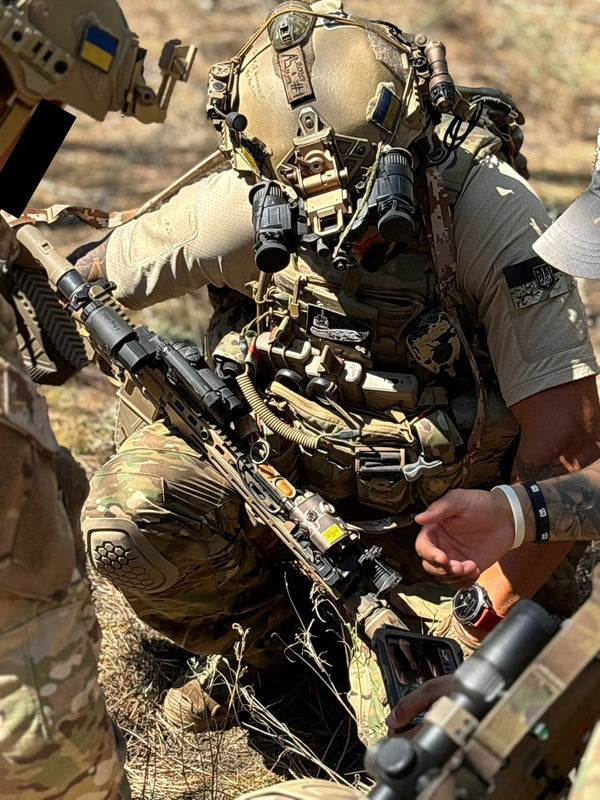
Rails. On a FAST-pattern helmet both side rails carry the headset arms, a light, goggle clips and sometimes a camera. The real constraint is shared space: an ARC-mounted headset occupies part of each rail. Mount the headset first, then put the light forward of it and IR markers or strobes on the top Velcro. Ops-Core even makes a headset mount that clamps to the rear of the rail to free the top section for accessories. Picatinny adapters let rail-less gear ride on ARC rails.
A classic MICH has no rails. Bolt-on side-rail kits exist — the Army's ACH, a MICH derivative, can be fitted with Picatinny rails for lights and cameras — but they only go through the holes the manufacturer provided. Without rails, lights and strobes ride on the cover's MOLLE panel or Velcro.
Shroud and NVG mount. FAST and EXFIL helmets ship with a shroud. Note that the NVG mount itself is usually sold separately, and Team Wendy states this for the EXFIL explicitly. High cut shells also carry bungee anchor points: Ops-Core's modular bungee shroud has clips for NVG retention, and EXFIL helmets include a shock-cord kit. On a MICH, a shroud goes on only through factory-drilled holes. Drilling a ballistic shell yourself weakens it, which is a lesson the MICH program itself was built on.
Eye and face protection. Rail-mounted ballistic visors and face shields are tied to a specific rail system; the EXFIL visor, for example, is made for Rail 3.0. Goggles attach to high cut rails with swivel clips; on a MICH they are held by rear strap anchors.
Common mistake: stacking the light, strobe and camera on one side. The helmet rotates towards the heavier side on every head turn. Split mass left and right.
Rail lights compatible with ARC, MOLLE and Velcro mounting are in Helmet Flashlights.
Weight, Balance and Fit: How Each Cut Wears Under a Full Loadout
Once a helmet is fully built, the three cuts end up within about 200 g of each other. What your neck actually feels is where that mass sits and how firmly the retention holds it.
Here is how our own builds add up, using the manufacturer weights listed for each component:
|
Build |
Shell |
Headset |
Light |
Cover |
Complete setup |
|
FAST-pattern high cut (Guardian Kit) |
1.45–1.65 kg |
~335 g |
47 g |
140 g |
~1.97–2.17 kg |
|
EXFIL-geometry high cut (Exfil ComTac Kit) |
1.35–1.55 kg |
~335 g |
55 g |
140 g |
~1.88–2.08 kg |
|
MICH-type mid cut (Middle-Cut Aramid) |
1.4 kg |
~335 g |
~50 g |
140 g |
~1.93 kg |
For reference, a standard MICH shell weighs 1.36–1.63 kg depending on size.
Balance. Night vision changes the picture. A PVS-14 monocular weighs about 351 g before the mount, and all of it hangs in front of your forehead. The fix is a counterweight at the back: a remote battery pack if your goggle uses one, or weights in the cover's rear pouch. Add mass until the helmet stays level when you look down with the chinstrap snug but not cranked. High cut covers usually include a rear counterweight pocket; on a MICH, the pouch goes on the cover or rear Velcro.
Retention. The MICH introduced a four-point chinstrap with seven pads, which is stable for a plain helmet. Under NVG load, dial-adjusted occipital retention holds better: Ops-Core's Head-Loc and Team Wendy's CAM FIT with a BOA dial pull a cradle up under the back of the skull, so the front load cannot lever the helmet down. On a MICH, compensate with tighter rear straps and firmer front pads.
Other gear. FAST geometry was shaped to cover the rear of the skull without riding on a carrier collar, which matters when you go prone. Before committing to any cut, check it in the prone position with your own carrier and pack. If you wear eye protection or a respirator, check strap clearance too: the open ear area of a high cut leaves room that a full cut does not.
Heat and hearing. Open ears vent heat and keep natural hearing and sound direction when you are not running comms. A covered ear muffles both.
Switching Cuts: Which Accessories Carry Over and Which Don't
When you move between MICH, FAST and other high cuts, most of the electronics come with you. Anything shaped to the shell or tied to its rail standard usually does not.
|
Carries over |
Usually does not |
|
Headset electronics and the headset itself |
Headset mounting: headband vs ARC arms, and generation-specific adapters |
|
NVG device and a standard NVG mount |
The shroud interface on a rail-less shell |
|
Lights and strobes with ARC, Picatinny or Velcro bases |
Rail adapters: ARC, EXFIL Rail 3.0 and bolt-on Picatinny are not interchangeable |
|
Counterweights and battery packs |
Covers, which are cut and size specific ("FAST fit", "Maritime fit") |
|
Patches and IR markers |
Pads, liner and retention system |
Before the first outing with a new shell:
- Identify the rail interface of the new helmet: ARC-type, EXFIL Rail 3.0 or bolt-on Picatinny.
- Match the headset adapter to both that rail and your headset's generation.
- Order the cover in the exact cut and size of the new shell.
- Fit the pads from scratch; do not copy the old pad layout.
- Re-balance the counterweight with the NVG mounted.
- Re-route the comms cable and test the PTT under the new cover.
Covers for each cut are in Helmet Covers.
Reference Setups: FAST, High Cut and MICH Builds
Three questions settle the cut for most people:
- Will you run night vision? If yes, go high cut with a factory shroud.
- Is comms on for the whole shift? If yes, go high cut with a rail-mounted headset.
- Is it daytime work where side coverage matters more than mounting space? If yes, go MICH-type.
FAST Helmet Setup — night work and constant comms
- Shell: FAST-pattern high cut, NIJ IIIA, factory rails and shroud
- Comms: active headset on ARC rail mounts (ComTac XPI or Earmor M32X Plus)
- Mounted: multi-mode rail light with IR, NVG mount on the shroud
- Balance: cover with a rear counterweight or battery pouch
- Weight: ~2.0–2.2 kg before night vision
- Build it: Guardian Kit – Ranger Green, Guardian Kit – Black
High Cut Helmet Setup — long shifts, lighter shell
- Shell: EXFIL-geometry high cut, NIJ IIIA, the lightest shell in our range at 1.35–1.55 kg
- Comms: 3M Peltor ComTac XPI on ARC arms via an EXFIL rail adapter
- Mounted: rail light, strobe on top Velcro
- Weight: ~1.9–2.1 kg complete
- Build it: Exfil FAST ComTac Mic Kit – Ranger Green
MICH Helmet Setup — maximum side coverage, minimal load
- Shell: MICH-type mid cut, NIJ IIIA
- Comms: low-profile headset on a behind-the-head band under the shell
- Mounted: light on the cover's MOLLE or Velcro; NVG only if the shell has factory shroud holes
- Weight: ~1.9 kg complete
- Build it: start from Ballistic Helmets
Every ready-to-run combination, with headset, light and cover matched to the shell, is in Ballistic Helmet Kits.
FAQ
Can I cut a MICH down to a high cut myself? No. Trimming or drilling a ballistic shell changes the tested geometry and voids its rating. If you need open ears, buy a factory high cut or a factory gunfighter-cut MICH.
Do FAST, high cut and MICH helmets use the same sizing? No. Sizing is specific to each manufacturer and shell. Measure your head circumference and use the chart for the exact helmet you are buying.
Do the same setup rules apply to bump helmets? For mounting and comms, largely yes, since many bump helmets copy FAST geometry. For protection they are a different product; see our FAST helmet guide.