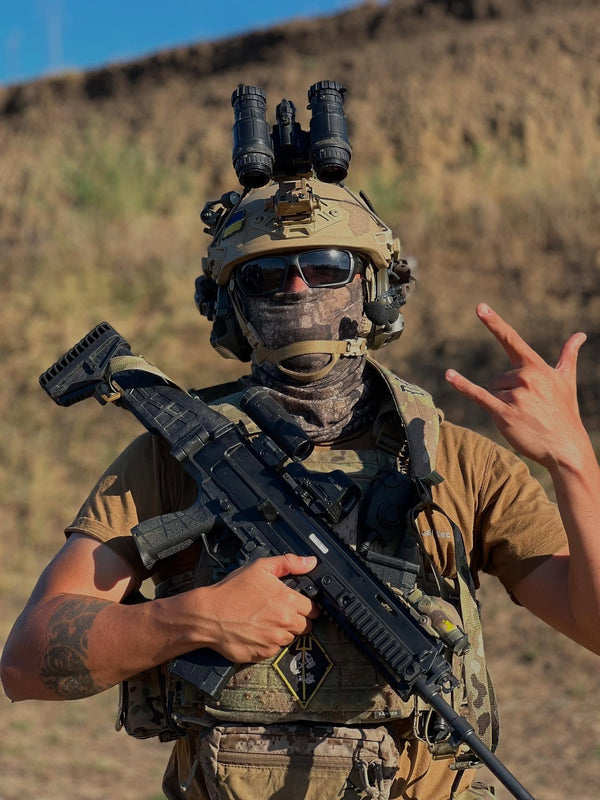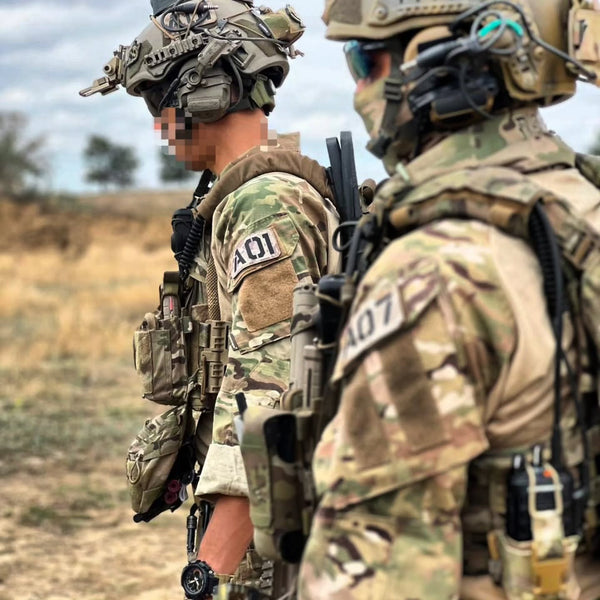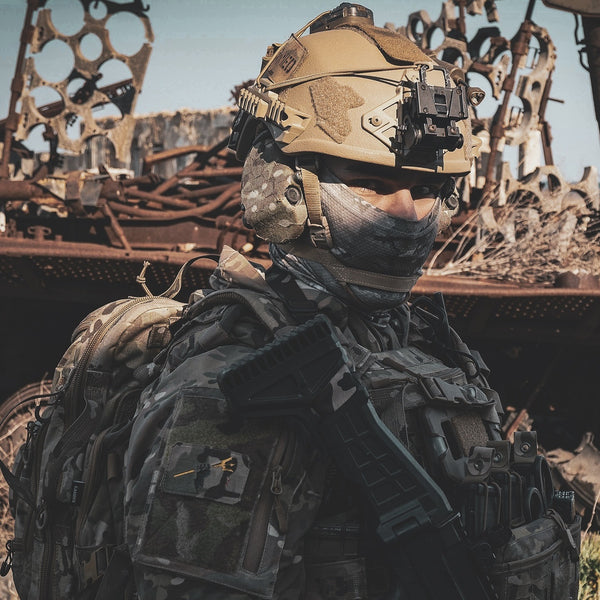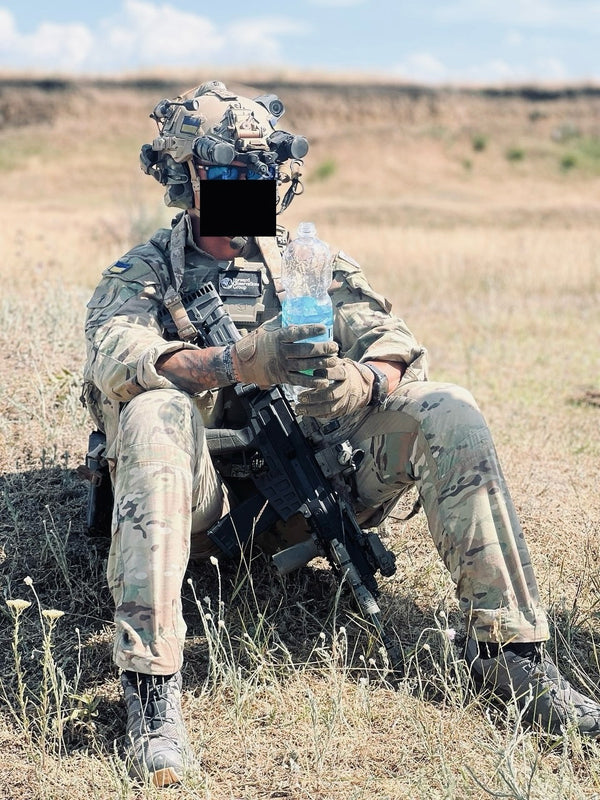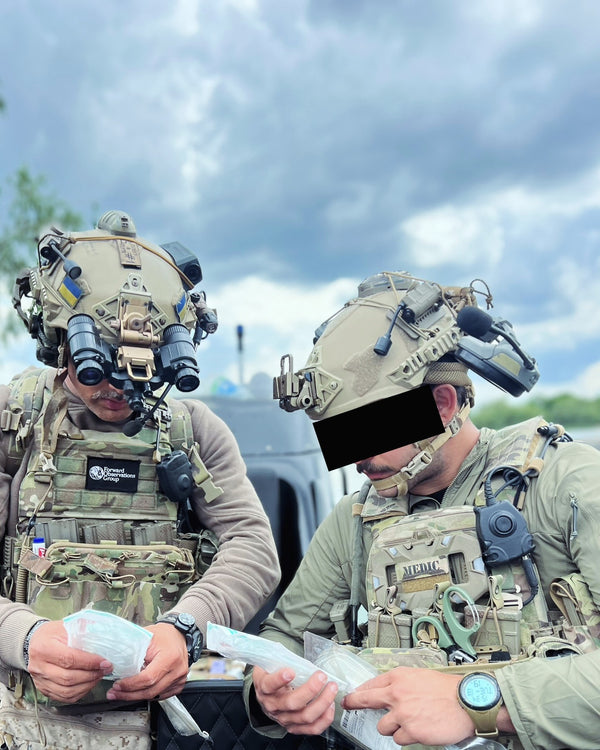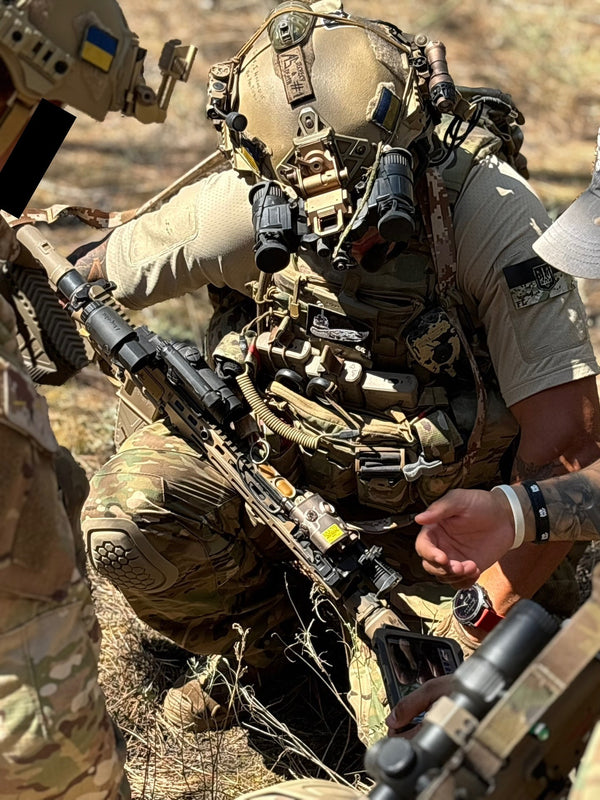


A ballistic helmet only protects the area it actually covers, and it only covers that area if it stays where it belongs. A helmet that rides up on the forehead, rocks when you turn your head or slides over your eyes when you go prone leaves your forehead or the back of your skull exposed, and it gets taken off at the first break because it hurts.
Getting the size right puts you in the correct shell. Fit is everything that happens after that: how the pads are arranged, how the retention dial and chin strap are set, and whether the helmet stays level once a headset, light or night vision is mounted. This guide walks through each step in the order you should do it, ending with a five-point check you can run in two minutes.
Start With the Right Size
No amount of padding fixes a shell that is too small, and very little fixes one that is far too big. Measure first:
- Run a soft tape around your head about 2 cm (¾ in) above the eyebrows and around the widest part of the back of the head.
- Take two or three measurements and use the largest one.
- If you wear a beanie or balaclava under the helmet, measure with it on.
On Blender helmets, a FAST or ATE FAST in M-L fits 54–58 cm and in L-XL fits 58–62 cm. The Exfil shell runs differently: M-L is 54–58 cm and L-XL is 60–64 cm. If you fall between two sizes, take the larger one and close the gap with thicker pads. The full tables are on our helmet sizing chart.

What a Good Fit Looks Like: the 5-Point Check
Run this check after you have set the pads, dial and chin strap (the next three sections explain how). Do it with the gear you will actually wear: headset, eye protection and any hood or beanie.
- Height. The front edge sits about one finger width above your eyebrows. Ops-Core's FAST manual puts the distance from the top of the eyebrow to the fitband at roughly 0.5–1 in (1.3–2.5 cm). Lower and it blocks your view when you look up or aim from prone; higher and your forehead is exposed.
- Level and centered. The front pad rests above the bony ridge of the brow, not on it, and the shell is not tilted back like a cap.
- Ears clear. There is room around the ears for a headset or earplugs, with no shell edge pressing on the ear cups.
- Shake and look-up test. Shake your head side to side and nod hard: the helmet moves with your head, not on it. Then look straight up at the ceiling: the rear of the helmet and the dial should not dig into your neck.
- Chin strap. You can slide one finger between the strap and your chin, and you can open your jaw and talk without the strap choking you.

If any point fails, go back to the step that controls it. Height and tilt are set by the pads, stability by the side pads and dial, and roll-off by the chin strap.
Ballistic Helmet Pads: How to Set Up the Padding
The pads are the main fitting system of a modern ballistic helmet. They hold the shell off your skull, set its height and angle, and absorb part of a blunt impact. Each position has its own job:
- Crown pad sets the height. Thicker lifts the helmet, thinner drops it.
- Front and rear pads set the tilt. A thicker rear pad pushes the shell forward; a thicker front pad pushes it back.
- Side pads remove side-to-side wobble and add side-impact protection.
Work from the top down. Put the helmet on with the dial fully loose so its whole weight rests on the crown pad, and check the height. Then adjust front and rear until the shell sits level, and only then fit the side pads. Ops-Core's own procedure follows the same order: set the top pads first, then the rear pad, and keep the thicker rear pad if you cannot feel a difference, because it makes the helmet more stable.

When something feels wrong, the cause is usually one pad:
|
Problem |
Likely fix |
|---|---|
|
Helmet slides over the eyes |
Thicker crown pad, tighten the rear dial |
|
Helmet sits high on the head |
Thinner crown pad; if that is not enough, the shell is too big |
|
Pressure on the forehead |
Thinner front pad |
|
Pain at the temples |
Thinner side pads |
|
Helmet wobbles side to side |
Thicker side pads, tighten the chin strap |
A few rules apply to every helmet:
- Run the full pad set. The US Army operator's manual for the Advanced Combat Helmet requires all pads to be worn in training and combat, and the hardware inside the shell must always be covered by padding. A bare nut against your skull is exactly where an impact will hurt you.
- Do not stack or improvise. Two pads on top of each other or a strip of camping foam change how the helmet behaves on impact. If you need more thickness, use thicker pads made for that shell.
- Be careful with aftermarket "4D" pad sets. They are mostly made for bump and airsoft helmets. In a ballistic shell, use pads specified for that model.
Some helmets also use a liner: a fitband or harness that holds the suspension together, sometimes with its own foam layer. On Blender helmets, the comfort pads sit on Velcro inside the shell and work together with a suspension of more than eight shock-absorbing cushions and a rear adjustment dial. The pads are covered in a water-resistant film with an antimicrobial wicking fabric, so sweat is less of a problem, but they still compress over time. When a pad no longer springs back or the Velcro stops holding, replace it.
Chin Strap and Retention: Dial First, Strap Second
The retention system has two parts that do different jobs:
- The rear dial tightens the fitband around your head. It keeps the helmet from shifting when you move.
- The chin strap keeps the helmet from rolling off forward or backward. It is not there to hold the helmet onto your head by itself.
Set them in that order. Tighten the dial until the helmet feels secure but not tight, then look up: if the dial presses into your neck, move the fitband higher. Ops-Core's manual describes raising or lowering the dial with the rear liner tabs for exactly this reason.
Then fasten the ballistic helmet chin strap and adjust the front and rear straps evenly until it is snug. If the helmet rocks forward into your eyes, tighten the rear straps; if it tips back off the forehead, tighten the front ones. The finished strap should allow one finger under the chin.
A tactical helmet chin strap that is too tight is as much of a problem as a loose one. If you cannot open your mouth to talk or drink, or the strap cuts in after 20 minutes, loosen it a notch. Check the buckle and straps before every use: they take wear every time the helmet goes on and off.
Counterweight: When You Need One and How Much
Everything you mount on the front of the helmet works like a lever on your neck. A night vision device of around 300–400 g, hanging in front of your eyes, pulls the helmet down and forward. You feel it in your neck within an hour, and the helmet starts to drift over your eyes even when the pads and dial are set correctly.
A ballistic helmet counterweight fixes this by putting weight on the back of the shell. The Ops-Core counterweight, a common reference, uses five removable 70 g weights in a rear pouch, so you can add or remove weight in small steps.
You do not always need one. Ops-Core's own manual says to add counterweight only when it is needed to balance a front load, because every gram you add is more load on the neck. In practice:
- Headset only. Usually no counterweight. A headset weighs around 310–335 g, but it sits on the sides of the helmet, close to the center of gravity.
- Light and strobe. A helmet light weighs around 50 g. No counterweight needed.
- Night vision or thermal on a front mount. This is where a tactical helmet counterweight earns its place.
To set it, mount the device in its working position, add weight in small steps and stop when the helmet stays level as you look down without you tightening the dial. If your device takes an external battery pack, mount it on the back of the helmet: it does the same job and the weight is useful. Our MK2 helmet battery pouch attaches to the rear Velcro or M-LOK and holds AA, AAA or CR123 batteries, so your spares become the counterweight. For PVS-31 battery packs there is a dedicated PVS-31 battery pouch.
Keep the total in mind. A Blender FAST helmet with a headset, light and cover comes to roughly 1.9–2.2 kg before night vision. With night vision and a counterweight you can be close to 3 kg, so a helmet that fits well becomes even more important.
FAQ
Should a ballistic helmet be tight? Snug, not tight. It should move with your head when you shake it, without pressure points after half an hour of wear. Pressure on one spot usually means one pad is too thick, not that the helmet is too small.
Can I use pads from another helmet? Only if the manufacturer lists them for your shell. Pad thickness and position are part of how a ballistic helmet is designed, so random pads or extra foam can leave hardware uncovered or change how the helmet sits.
My helmet fits without a headset but not with one. Why? A headset changes where the shell can sit. Check that the ear cups are not pushing the helmet up, and fit the helmet with the headset on from the start. How the cut of the shell affects headset fit is covered in our FAST vs High Cut vs MICH helmet setup guide.
Where can I buy a helmet that is already set up? Our ballistic helmet kits come with a headset, rail adapters, light and cover matched to the shell, so all that is left is the fitting in this guide.